
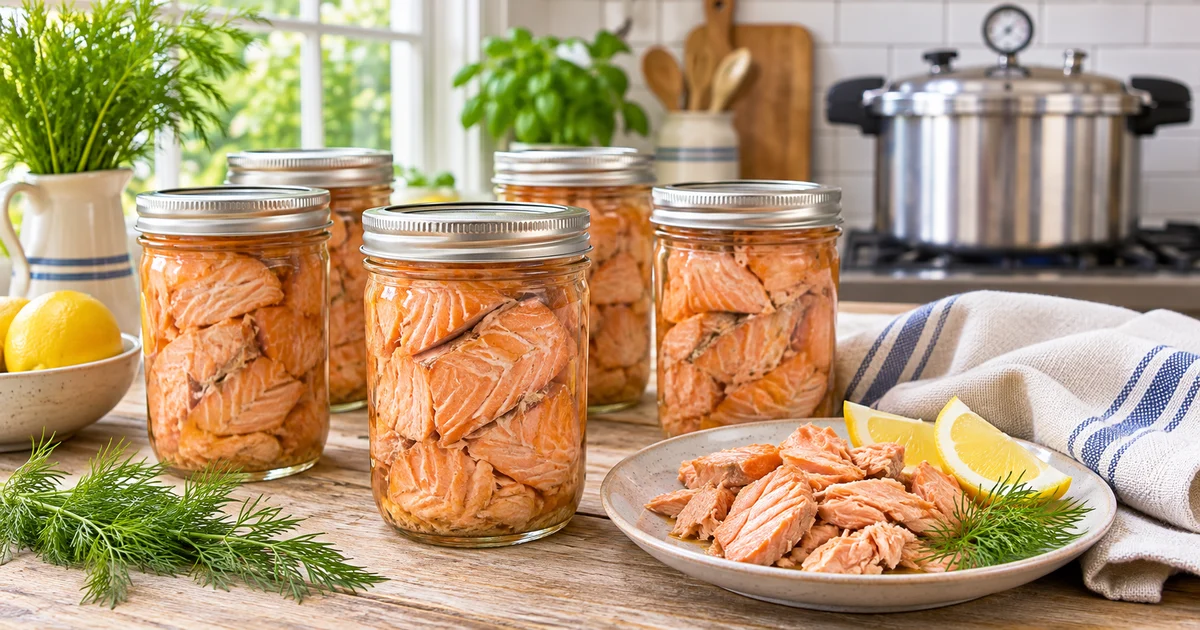
Home-canned salmon is a convenient pantry ingredient for salmon cakes, salads, chowder, pasta, and sandwiches. This guide follows the tested USDA/National Center for Home Food Preservation method for raw-packed fatty fish in pint jars.
Important: salmon is a low-acid food and must be processed in a true pressure canner. A boiling-water bath, steam canner, oven, multicooker, or electric pressure cooker is not a safe substitute.
Prep: 45 min · Process: 100 min · Cooling: varies · Total: about 4 hr
Cuisine: American · Course: Preserving
Safe Pressure-Canned Salmon
Ingredients
Equipment
- True stovetop pressure canner with dial or weighted gauge
- Standard pint canning jars, new lids, and bands
- Jar lifter, canning funnel, bubble-removal tool, and clean towels
Instructions
- Read the pressure canner and lid manufacturers’ instructions. Inspect the canner, confirm that a dial gauge is accurate, prepare clean pint jars, and determine your altitude before choosing the required pressure.
- Remove the salmon head, tail, fins, and scales. Wash away all blood, split the cleaned fish lengthwise if desired, and cut it into 3½-inch lengths. Keep the fish chilled while working.
- Pack the raw salmon firmly into pint jars with the skin side facing the glass, leaving 1 inch of headspace. Add 1 teaspoon of canning salt per pint if desired. Do not add liquid.
- Remove air pockets gently, recheck the 1-inch headspace, and wipe each rim clean. Center the lids and apply bands fingertip-tight.
- Load the pressure canner with the amount of water specified by its manufacturer. Lock the lid, heat with the vent open, and vent a steady column of steam for 10 full minutes. Pressurize and process pint jars for 100 continuous minutes at the correct pressure for your altitude.
- Turn off the heat and allow the canner to return to zero pressure naturally; never force-cool it. Wait as directed by the manufacturer, open the lid away from your face, and remove jars upright. Leave undisturbed for 12–24 hours, check the seals, remove bands, label, and store.
Estimated per 3-ounce serving: 170 calories · Protein 22 g · Fat 9 g · Carbs 0 g · Sodium 410 mg when salt is added
Pressure and Altitude Chart
Dial-Gauge Pressure Canner
- 0–2,000 feet: 11 pounds pressure
- 2,001–4,000 feet: 12 pounds pressure
- 4,001–6,000 feet: 13 pounds pressure
- 6,001–8,000 feet: 14 pounds pressure
Weighted-Gauge Pressure Canner
- 0–1,000 feet: 10 pounds pressure
- Above 1,000 feet: 15 pounds pressure
Process pint jars for 100 minutes at the listed pressure. If pressure falls below the required level at any time, bring the canner back to pressure and restart the full 100-minute processing time.
Essential Safety Rules
- Use only tested directions for the exact fish, jar size, pack style, time, and pressure.
- Use standard pint or half-pint canning jars; half-pints use the same 100-minute time.
- Never use water-bath canning for salmon.
- Do not add oil, broth, vegetables, herbs, lemon, or sauce to the jars unless following a separately tested recipe.
- Let the canner depressurize naturally; forced cooling can cause liquid loss and seal failure.
- Discard any jar that is unsealed, leaking, bulging, spurting, moldy, or has an unnatural odor. Never taste suspicious food.
Three Easy Canned Salmon Recipes
1. Lemon-Dill Salmon Salad
Drain one pint of salmon and combine it with mayonnaise, lemon juice, chopped celery, dill, black pepper, and capers. Serve in sandwiches or lettuce cups.
2. Crispy Salmon Cakes
Mix drained salmon with an egg, breadcrumbs, scallions, Dijon mustard, and lemon zest. Form patties and pan-fry until golden and heated through.
3. Quick Salmon Chowder
Simmer diced potatoes and onion in broth until tender. Add corn, milk or cream, and drained canned salmon; heat gently and season with dill and black pepper.
Storage
Store sealed jars without bands in a cool, dark, dry place. For best quality, use within one year. Refrigerate any unsealed jar immediately and use within a few days, or freeze the contents in a freezer-safe container.
Frequently Asked Questions
Can I can salmon in a boiling-water bath?
No. Salmon is a low-acid food. Pressure canning is the only recommended home-canning method capable of reaching the temperature needed to control botulism risk.
Should I add water to the jars?
No. The tested raw-pack method specifically says not to add liquid; salmon releases its own juices during processing.
Are crystals in canned salmon dangerous?
Small glass-like crystals may occasionally form in canned salmon. The National Center for Home Food Preservation notes that these are usually harmless magnesium ammonium phosphate crystals and often dissolve when heated.
Can I use quart jars?
Quart jars require a different tested process of 160 minutes and special operating guidance. This recipe intentionally uses the standard pint-jar method; do not apply the pint instructions to quarts.
This recipe follows published USDA/National Center for Home Food Preservation guidance for raw-packed fatty fish in pint jars. Always consult the current official directions and your pressure-canner manufacturer before canning. Nutrition is an estimate.
Featured image: AI-generated food photography.